
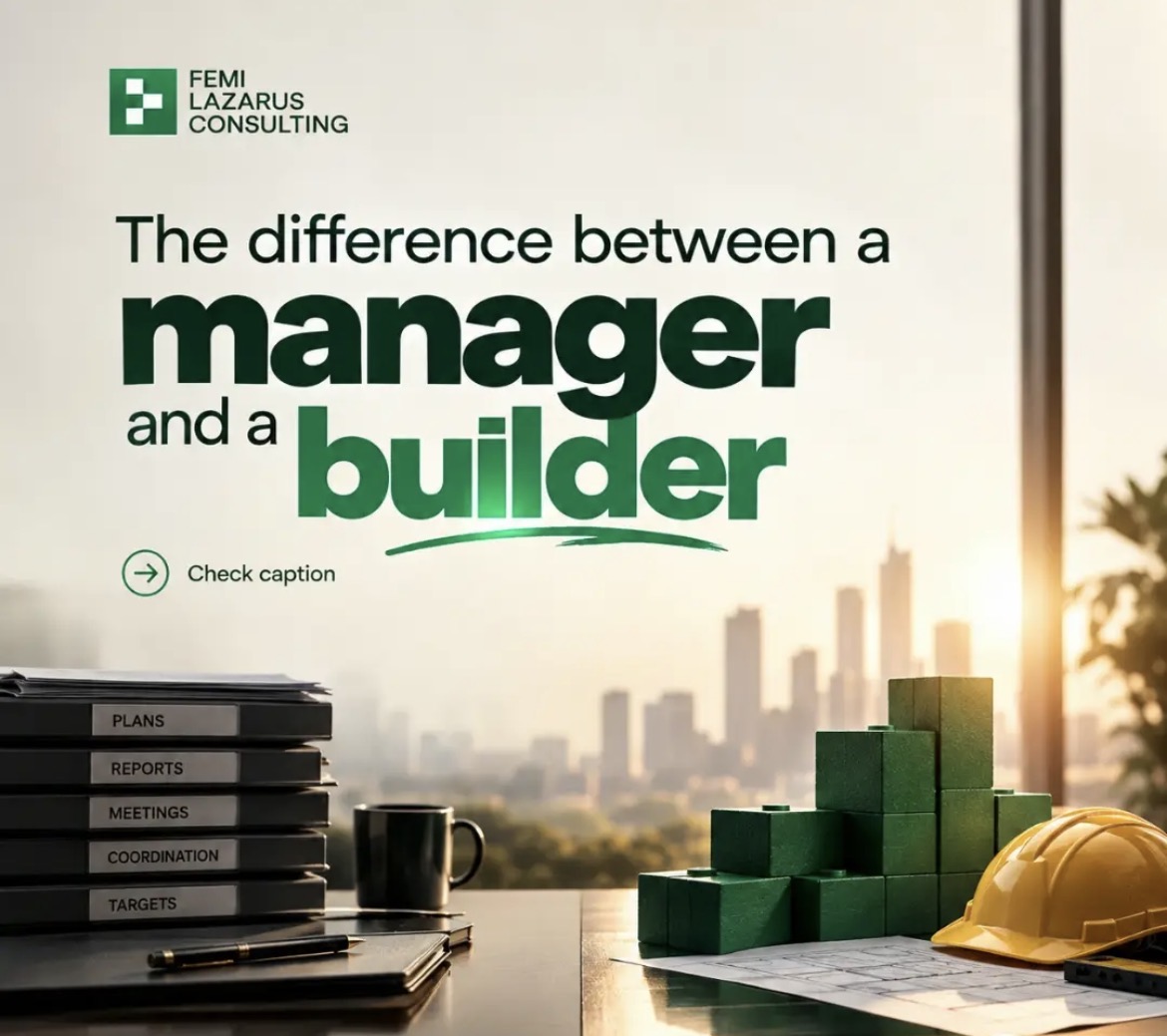
Across the organizations we have worked with, the distinction of orientation shows up more consistently than almost any other distinction. Two leaders can sit in the same room, inherit the same resources, operate in the same industry, and produce entirely different kinds of organizations. This happens many times because one manages what exists while the other builds what should exist.
Understanding the difference between these two orientations is not an academic exercise. It is one of the most practically important things a leader can do, because you cannot lead an organization to where it has never been if you are only equipped to manage where it currently is.
What a Manager Does
To be clear from the start, management is not a lesser calling. Every organization needs it and without management, even the best-built institutions will fall into disorder.
The ability to coordinate people, maintain systems, meet targets, and sustain what has been built is genuinely valuable and genuinely difficult but management, at its core, is a preservationist act. It is concerned with what exists. A manager's primary orientation is toward the current state of the organization, its processes, its people, its performance against established benchmarks. The manager's question is how do we keep this running well?
This is a necessary question. It is not, however, a sufficient one for organizations that are trying to grow, evolve, or build something that does not yet exist.
When management becomes the dominant mode of leadership in an organization that needs to be built, the results are predictable. The organization becomes increasingly efficient at doing what it has always done. It optimizes existing processes rather than questioning whether those processes still serve the mission. It measures progress against historical performance rather than against the scale of what it is trying to become. It protects what it has built, sometimes at the cost of what it could build.
Managed organizations do not usually collapse dramatically. They plateau quietly. And the plateau feels safe until it does not.
What a Builder Does
A builder's orientation is toward what does not yet exist. The builder's primary question is not how do we keep this running well but rather what should this become, and what needs to be true for us to get there.
This is a fundamentally different posture that requires a tolerance for uncertainty that management does not. It also requires the ability to hold a picture of something that has not been built yet and make decisions in the present that serve that future picture, even when those decisions create friction with what currently exists.
Builders are not reckless. The best builders we have encountered are among the most disciplined thinkers in any room. But their discipline is applied differently. Where a manager's discipline is applied to maintaining standards within existing systems, a builder's discipline is applied to designing the systems that will be needed at the next level of the organization's growth.
Builders ask different questions. Not just what are our numbers this quarter, but what structure do we need to build this year so that our numbers three years from now are even possible. Not just how do we solve this problem, but why does this problem keep occurring and what would have to change at a systemic level to stop it from recurring.
That shift in questioning changes everything about how an organization develops.
Why This Distinction Matters Now
Most leaders begin their journey as builders because the early seasons of building an organization require it. When resources are scarce and structures are thin, the leader has no choice but to operate in construction mode, assembling the pieces of something new from whatever is available. But as the organization grows, the very success of the building phase creates the pressure to shift into management mode. There are now systems to maintain, people to coordinate, and stakeholders to satisfy.
The organization's complexity increases and with it, the demand for managerial attention.
Many leaders make this shift without realizing it. They move from building the organization to managing it and they do not go back. The building mindset that created the organization gets replaced by a management mindset that sustains it and the organization, which still needs to be built at higher and higher levels, begins to stall.
This is one of the most common patterns we encounter at Femi Lazarus Consulting. Leaders who built something real in the early years and then, without quite knowing when it happened, found themselves managing rather than building. The organization is functional but not growing and nobody can explain why.
The explanation is almost always that the building stopped.
The Builder's Tools
Builders and managers do not just think differently, they use different tools.
A manager's primary tools are systems of accountability, performance reviews, reporting structures, and operational frameworks. These are the tools of preservation and they are genuinely important.
A builder's primary tools are clarity, structure design, and long-range thinking. Builders spend significant time on questions that have no immediate operational payoff. They sit with questions like;
What kind of organization do we need to be in five years and what does that require us to build today?
What are the structural limitations that are currently invisible to us because we have been working around them for so long?
Where is the organization's growth being constrained not by effort but by design?
And these are not questions that produce results next quarter. They are questions that produce results in the quarters after that and the quarters after those.
This is the reason why building is harder to sustain than managing.
Managing produces visible, near-term results while building produces results that are most times only legible in retrospect.
The leaders who resist the pull back into pure management mode, who protect time and energy for the building questions even when the operational demands are loudest, are the ones whose organizations tend to compound over time rather than plateau.
Both Are Necessary But The Sequence Matters.
This is where many conversations about management and building go wrong. They treat the two orientations as mutually exclusive, as though a leader must choose one and abandon the other but that is not the argument we are making here.
Every leader needs both orientations.
Every organization needs both management and building happening simultaneously. The question is not which one to choose but which one to lead with at any given stage of the organization's development, and whether the leader is conscious enough of their own default orientation to compensate for it when necessary.A leader who is naturally a builder needs to ensure that the management layer of the organization is strong enough to hold what is being built. A leader who is naturally a manager needs to ensure that they are not so absorbed in sustaining what exists that they have stopped building what should exist.
The most effective leaders we have worked with are not those who have mastered one orientation but those who know which orientation they default to, understand when the organization needs the other one, and have either developed the range to provide it or have built a team that can.
This kind of self-awareness is not a personality trait but a leadership discipline. Like all disciplines, it has to be chosen deliberately, developed consistently, and protected fiercely.
The Question We Need To Ask
If you are leading an organization right now, this question is worth sitting with before you move on.
When you look at how you have spent your leadership energy over the last ninety days, how much of it was spent managing what exists and how much of it was spent building what should exist?
For this, there is no right answer in absolute terms but there is a right answer for your organization at its current stage. And if you are honest about that answer, it will tell you more about where your organization is headed than any strategy document will.
At Femi Lazarus Consulting, helping leaders understand their own orientation and build organizations that can grow beyond it is one of the most important parts of the work we do.
If this conversation is one your organization needs, and you are ready to have it, let’s have it.
Femi Lazarus Consulting is a leadership, strategy, and institution-building practice. We work with leaders, founders, executives, and institutions who are serious about building organizations that endure. To begin a conversation, visit www.femilazarusconsulting.com