
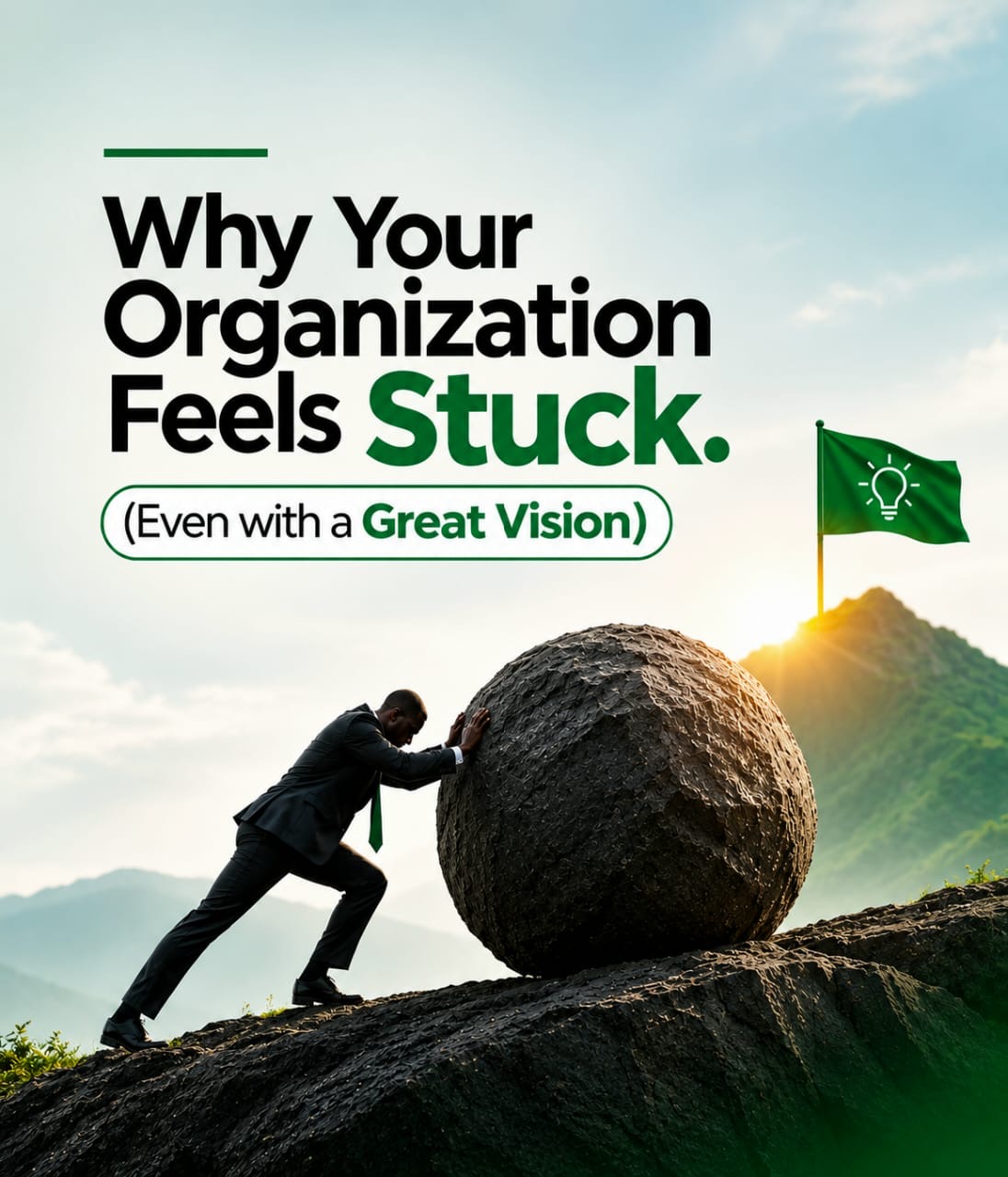
There is a kind of frustration that we do not talk about enough in many leadership circles and it is not the frustration of having nothing but the frustration of having everything on paper and still going nowhere fast.
Yes, you have the vision, you have a team and you have put in the years yet the organization keeps hitting the same walls, having the same conversations, and producing the same results.
If this dilemma sounds familiar, you are not alone and more importantly, you are not the problem.
The Myth of the Vision Problem
When organizations stall, the first instinct is almost always to revisit the vision. This is when we find leaders call retreats, consultants are brought in and new mission statements are crafted. Then everybody leaves energized, and three months later, the organization is stuck again in exactly the same place.
This cycle is exhausting because it is built on a false diagnosis.
The organizations we work with at Femi Lazarus Consulting are hardly ever stuck because their vision is wrong but because their vision has not yet been translated into a structure that can carry it.
Vision without structure is not a strategy, it is an aspiration and aspiration (or passion), no matter how compelling, cannot run an organization.
The hard truth is that your organization does not need a better vision, it needs a structure that makes your current vision executable.
What Organizational Stuckness Actually Looks Like
Organizational stuckness would hardly announce itself dramatically. It would not necessarily arrive as a crisis but it will creep in quietly, through patterns that have become familiar to the point where they have stopped being noticed.
These are what it tends to look like in practice;
1. Decisions take longer than they should. Not because the team lacks intelligence, but because nobody is clear on who actually owns what. Every significant choice migrates upward to the leader, not because people are incapable of deciding, but because the structure has not given them the authority or the framework to decide with confidence.
2. The same problems keep returning. You solve something, move on, and three months later it is back. The problem is not a people problem, it is a systems problem. Without structures that hold solutions in place, organizations will revert to their defaults every time.
3. Growth happens but progress does not. The team gets bigger, the workload increases, the complexity multiplies but the sense of forward momentum never really materializes. This is one of the most disorienting experiences for a leader appearing as visible growth that somehow does not feel like winning.
4. The leader becomes the bottleneck. This is likely the most obvious sign. When an organization cannot move without the founder or senior leader in the room, it has not been built. It has been staffed. There is a significant difference between building and staffing.
The Real Culprit: The Clarity Gap
At the center of most organizational stuckness is what we call the clarity gap. It is the distance between where the leader believes the organization is going and what the people inside the organization actually understand about that direction.
This gap is never really intentional. It just forms gradually, through assumptions that were never made explicit, priorities that were never clearly ranked, and decisions that were made without a shared framework for making them.
When the clarity gap is wide, people work hard in different directions. Effort does not compound, energy dissipates and the organization produces motion without momentum.
Leaders tend to assume that because something is clear in their minds, it is clear to everyone else. This is one of the most natural and most costly assumptions in organizational life. Clarity does not transfer by proximity and it does not move through an organizational chart on its own. It has to be deliberately built, communicated in specific terms, and then embedded into the structures and systems people use to make decisions every day.
Closing the clarity gap requires more than better communication. It requires a deliberate process of translating vision into shared, specific, actionable understanding. Not just what the organization is building, but what it is not building. Not just where it is going, but what success looks like at specific points along the way. Not just the priorities, but the order of the priorities and who owns each one. The last point being the most important and the most consistently avoided.
Clarity, in this sense, is a decision and not a feeling and it has to be made deliberately, not hoped for.
Structure Is Not the Enemy of Vision
One of the most persistent misconceptions in organizational leadership is that structure constrains vision. That building systems and processes somehow diminishes the boldness or the creativity of what you are trying to create.
The opposite is true.
Structure is what would allow the vision to scale. It is what would make the organization function without requiring the founder to personally hold everything together. It is what would give a team the freedom to execute without constant supervision, because everyone knows what they own, what good looks like, and how decisions get made.
A well-designed organizational structure does not constrain bold leadership but distributes it. It takes what a leader carries alone and builds it into how the organization thinks, decides, and operates, so that the vision is no longer dependent on one person's presence to survive. The organizations that endure are built on systems strong enough to hold the vision in place even in the leader's absence.
Building that kind of structure is not an act of administrative caution. It is one of the highest forms of strategic leadership.
Three Questions You Need To Find Answers To
If your organization is experiencing any of what has been described here, these three questions are worth answering honestly, not in a team meeting, but alone, before the next strategy session.
First: Can everybody on your leadership team articulate, in specific terms, what your organization is building and what success looks like in the next two years? Not just the vision statement but the specific definition of success.
Second: If you were removed from every operational decision for the next thirty days, would the organization continue to function? Not thrive now but simply function. If the honest answer is no, the organization is structured around you, not around itself.
Third: What is the one structural problem your organization keeps working around instead of fixing? There is almost always one and it would become invisible through familiarity. So, name it.
These questions would not have comfortable answers but the discomfort they would produce is useful as it points directly at the work that matters.
The Work Ahead
Organizational stuckness is not a permanent condition, it is a signal. It tells you that the structure beneath your vision has not kept pace with the scale of what you are trying to build.
When an organization has been stuck for a while, the temptation is to look for a dramatic solution in the form of a new hire who will shift the culture, a pivot that will unlock momentum or a rebrand that will signal a new era. In our experience, dramatic solutions hardly address the elephant in the room. They might move the furniture but they do not fix the foundation.
The path forward is not another vision exercise. It is the deliberate work of making clarity explicit rather than assumed, designing structures that distribute authority rather than concentrating it, and creating execution systems that hold the organization accountable to itself, independent of who is in the room on any given day.
That work is not going to be quick but it is the work that separates organizations that last from organizations that barely survive their early years and it is the work that produces what no retreat can; an organization that compounds over time, that grows stronger as it scales, and that is genuinely capable of building something that endures.
At Femi Lazarus Consulting, this is the work we do every day, with leaders and organizations who are serious about building something that lasts.
If your organization is ready for that conversation, so are we.
Femi Lazarus Consulting is a leadership, strategy, and institution-building practice. We work with leaders, founders, executives, and institutions who are serious about building organizations that endure. To begin a conversation, visit www.femilazarusconsulting.com